
This post is written by the Social Inclusion & Economic Empowerment Project (SIEEP) team at ActionDignity
At a glance: Learning Where Health Begins
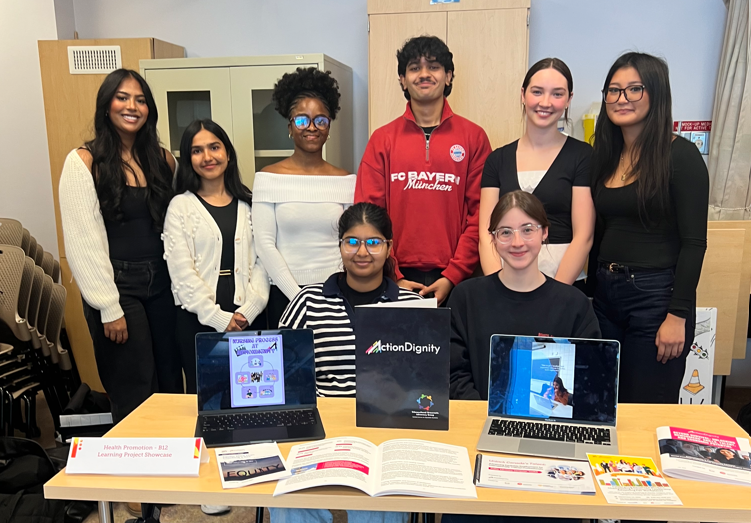
What does employment, discrimination, or a sense of belonging have to do with our health? More than we might think. Through a recent community health promotion placement, eight second-year nursing students from the University of Calgary collaborated with ActionDignity’s Social Inclusion & Economic Empowerment Project (SIEEP) to explore how social and structural conditions shape individual and community wellbeing, often long before someone enters a healthcare setting.
Throughout the placement, students engaged with grassroots community leaders and Community Connectors, explored ActionDignity’s community-based participatory research, and learned how barriers such as foreign credential non-recognition and employment discrimination can affect not only economic opportunities but also mental health, confidence, family relationships, and belonging. Drawing on ActionDignity’s Beyond Survival research, students also developed short videos to help communicate these findings to wider audiences.
The experience highlighted an important lesson for future healthcare professionals: understanding health means understanding the broader circumstances of people’s lives. It also demonstrated the value of bringing community knowledge, education, and advocacy together to address systemic barriers and advance health equity.
What shapes a person’s health?
For much of modern healthcare history, the most visible answers were disease, biology, individual behaviour and access to medical care. Over time, public health thinking increasingly recognized that health is also produced far beyond hospitals and clinics, through the conditions in which people live, learn, work, build relationships and participate in society.
This understanding was at the heart of a recent collaboration between ActionDignity’s Social Inclusion & Economic Empowerment Project (SIEEP) and eight second-year nursing students from the University of Calgary Faculty of Nursing.
Through community engagement, research, and experiential learning, students explored an important question: How do social systems, community relationships, and lived experiences shape health before someone ever becomes a patient?
Why SIEEP and Nursing?
SIEEP works with racialized newcomer communities on social inclusion, economic empowerment, community leadership and systems change. One of its major community research initiatives, Beyond Survival: Unlocking Newcomers’ Skills, Talent, and Economic Potential, examined how non-recognition of foreign credentials and requirements for Canadian work experience affect racialized newcomers.
At first glance, foreign credential recognition may appear to be an employment policy issue. The community evidence showed something much wider.
Among 506 research participants, 62.2% reported anxiety, stress or depression associated with their employment experiences, and 45% reported feeling undervalued because they could not obtain employment aligned with their skills and experience. Housing affordability, food insecurity or financial strain, and family conflict also emerged alongside employment barriers.
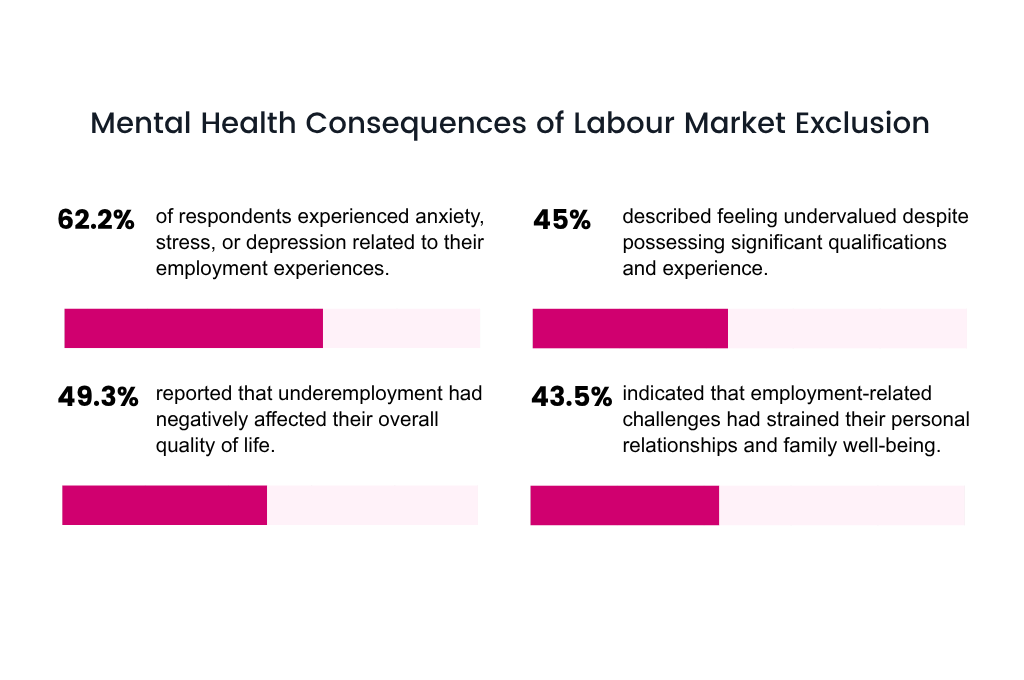
The research therefore provides an applied example of a central public-health principle: an employment system can also become a health determinant. A professional unable to re-enter their field may lose income, but the effects do not stop with income. Employment can influence housing stability, social status, identity, relationships, confidence, belonging and opportunities for participation. These conditions interact rather than operate independently.
One student summarized this learning simply, yet profoundly: “Everything is deeper than it seems.”
Another reflection described social problems as branches connected to different parts of people’s lives, suggesting that addressing the root of an issue can improve several outcomes at once.
For nurses in training, this creates an important extension of clinical thinking. Understanding someone’s health means asking not only what has happened to the person, but also what conditions surround that person’s life.
Co-designing a placement around community knowledge
The placement was jointly shaped by the University of Calgary instructor and ActionDignity’s SIEEP program to meet the learning requirements of a community health promotion practicum while remaining meaningful to ActionDignity and its communities.
The students were not positioned simply as observers visiting a community organization, nor were community members positioned as people for students to study. Instead, the collaboration drew on the principles already underpinning SIEEP’s Community-Based Participatory Action Research, or CBPAR.
In the Beyond Survival study, communities were treated as partners in knowledge production. A CBPAR Steering Committee of grassroots leaders and people with lived experience helped refine research questions, review tools, support recruitment, interpret findings and determine knowledge-mobilization priorities. Six ethnocultural organizations supported community engagement and helped strengthen the accessibility and relevance of the research.
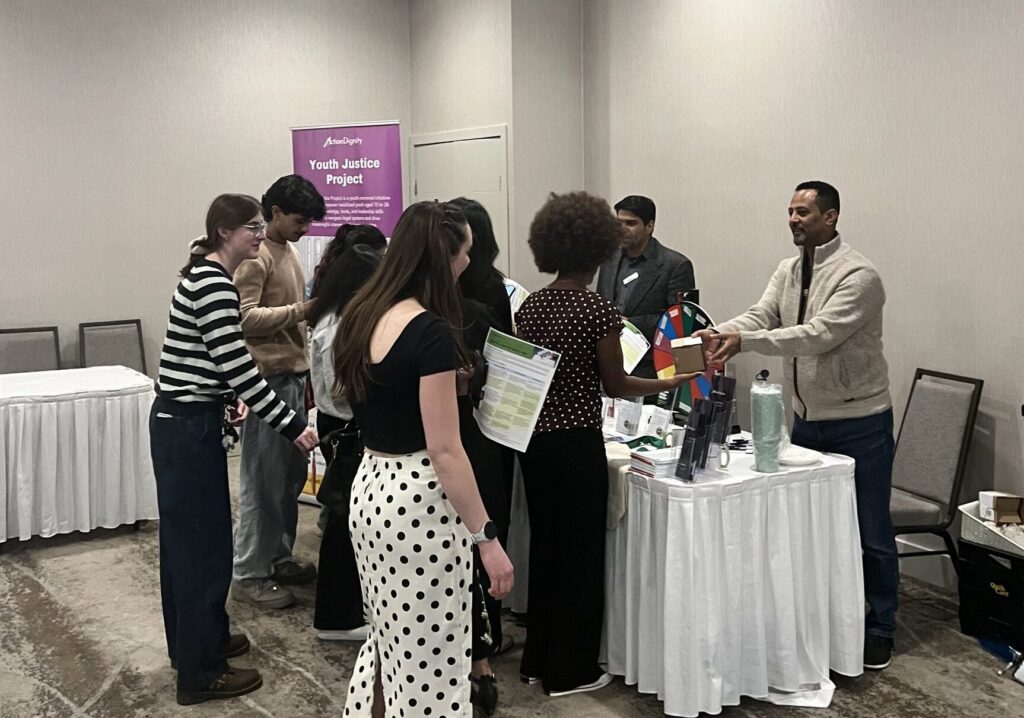
The nursing placement followed the same principle. Students learned about social inclusion and structural determinants, but they also engaged directly with Community Connectors and grassroots leaders who could explain what community engagement looks like from within communities. That experience challenged some of their starting assumptions. The students reflected that they had initially understood “community” as a broad concept. Through the placement, they began recognizing that people may belong to many communities at once, and that community is shaped by identity, relationships, experience, and a person’s own sense of belonging.
They also identified intersectionality as a recurring theme, recognizing that employment, race, gender, culture, education, income and social status may overlap to produce very different experiences for different people.
Community expertise and nursing practice
This learning has relevance for nursing, as Nurses routinely meet people at points where physical health, mental wellbeing and social conditions intersect. Yet a clinical encounter provides only a small window into someone’s life.
Students reflected on the importance of seeking that wider context rather than reducing a patient to one diagnosis, behaviour or presenting issue. One group reflection captured this as:
“Nursing is very context-based. Seek the context in patients’/client’s lives.”
They also linked cultural safety with learning, examining assumptions and understanding what matters to the community before deciding what support should look like.
This parallels ActionDignity’s approach to community work. Community members are not simply recipients of programs. They carry knowledge about the barriers affecting their lives, the strengths already present within communities, and the changes that are likely to be meaningful.
From healthcare to the conditions that create health
The lessons emerging from this placement reflect a broader shift in how health has been understood over the past several decades. While healthcare has traditionally focused on disease, treatment, and individual behaviour, public health thinking has increasingly recognized the importance of social, economic, and environmental conditions in shaping wellbeing.
Canada has played an important role in the evolution of this thinking. The 1974 Lalonde Report, A New Perspective on the Health of Canadians, challenged an overwhelmingly healthcare-centred understanding of health by proposing that health is influenced by human biology, lifestyle, environment and the organization of healthcare. The Public Health Agency of Canada notes that this helped establish the idea that improvements in health could come from changes in social and physical environments, not only from increased healthcare spending.
The 1978 Declaration of Alma-Ata further connected health with social and economic conditions. The Ottawa Charter for Health Promotion, adopted in 1986, went further still. It identified peace, shelter, education, food, income, a stable ecosystem, sustainable resources, social justice and equity as fundamental prerequisites for health. It also placed community action, supportive environments and healthy public policy alongside individual skills and healthcare services as essential components of health promotion.
In 2008, the World Health Organization’s Commission on Social Determinants of Health consolidated decades of evidence demonstrating that social disadvantage translates into differences in illness, health and premature mortality. Today, the Public Health Agency of Canada describes determinants such as income, education, decent work, job security, housing, social support and freedom from discrimination and violence as conditions with lasting effects on health.
This is where the work of a social inclusion organization like ActionDignity and the education of future nurses meet.
From learning to reciprocity
An important principle of this placement was reciprocity. The students’ role was not only to learn from ActionDignity and community members. Their placement also needed to leave something useful behind.
Through conversations with SIEEP and community leaders, the group focused its contribution on a challenge already identified through the CBPAR process: making complex research findings more accessible to wider audiences.
Students therefore developed short knowledge-mobilization videos, drawing on the findings around foreign credential recognition and its wider impacts. Drafts were reviewed by ActionDignity, revised based on feedback and returned as final resources at the conclusion of the placement. This process reflected an important lesson in community-engaged work. A resource is not useful merely because it has been produced. Its purpose, audience, framing and accessibility need to be shaped by the people and work it is intended to support.
Advocacy is also a health conversation
One of the clearest changes visible in the students’ reflections was their understanding of advocacy.
Through the placement, students observed that some health risks cannot be adequately addressed through individual education or clinical intervention alone. If the underlying issue involves employment access, discrimination, housing insecurity or another structural condition, meaningful prevention may also require policy and systems change.
This is consistent with the Ottawa Charter’s original understanding of health promotion. Advocacy, community action, and healthy public policy were never separate from health. They were part of creating conditions that allow people to be healthy.
For ActionDignity, this is also why community research matters as it can document what communities already know through lived experience, make patterns visible, connect individual experiences to systems, and provide evidence communities can use in advocacy. For nurses entering a profession grounded in care, the lesson may be equally important: sometimes caring for health also means understanding, and where appropriate helping to challenge the conditions producing inequity.
For eight future nurses, the placement offered an opportunity to begin seeing those connections before entering professional practice. For ActionDignity, it created another pathway for community evidence to travel beyond the communities and systems where it was first generated.
And for both, it demonstrated that learning about health can begin by learning how to understand community.