
This blog post is written by the “Anti-Racism Blog Team” of ActionDignity and is the intellectual property of ActionDignity. Unauthorized use and/or duplication of this material without express and written permission from ActionDignity is strictly prohibited. Excerpts and links may be used, provided that full and clear credit is given to ActionDignity with appropriate and specific direction to the original content.
We encourage you to check our Systems-Led Anti-Racism Glossary to access the definition of the terms that will be discussed in our blog series.
(13 mins read)
Overview
This blog post shares how we can understand systemic racism by looking at the non-recognition of foreign credentials as a prime example. We examine the following:
- The three main elements of racism
- Differences between interpersonal, structural, and systemic racism
- The non-recognition of foreign credentials as an example of systemic racism, indicated by:
- Lived experiences
- Researched pattern of behaviour
- Impacts on racialized communities
- Ways to get involved in anti-racism systems change to impact this problem.
What is Systemic Racism?
Anti-racism systems change requires us to be able to define and identify racism. In the past, we may have been taught to think of racism as solely the act of being discriminated against because of prejudiced views about skin colour. This definition can be misleading in a few ways. First, it can suggest that there is something to judge about our skin colours. Each of our skin tones is beautiful. Each person is made perfectly, and there is nothing wrong with our skin colours. Secondly, racism is much more than individuals prejudging each other. Racism is the way systems and structures categorize people by race and assign more value to some and less to others to control resources and power (Alberta Civil Liberties Research Centre, n.d.). With this definition, we can understand racism as the connection of 1) categorizing humans into the socially created categories of race 2) placing those racial categories on a hierarchy that assigns more value to some and less to others, and 3) using that hierarchy to justify control of resources and power. These three elements of racism lead to diminishing racialized people’s experience of safety, dignity, and belonging, and ultimately lead to their marginalization and disconnection from the greater society.
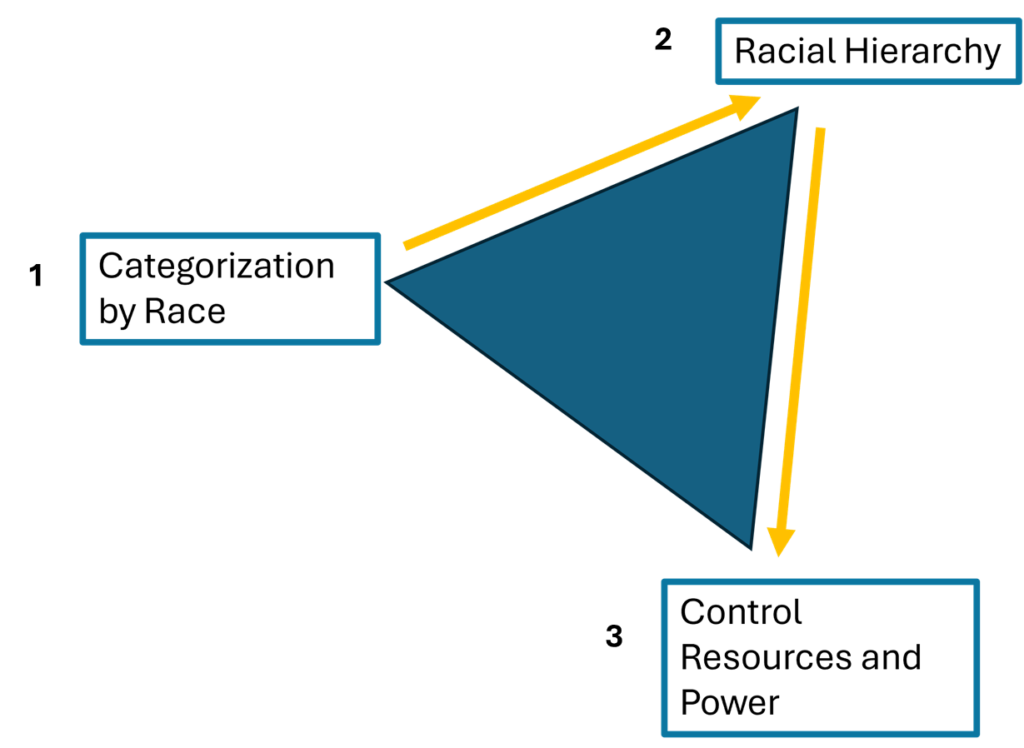
When we think we may have experienced racism, it can be helpful to notice that those three elements will be present. This structure of racism can be seen in many ways in society. We may notice or experience interpersonal racism, structural racism, and systemic racism.
Interpersonal racism presents in the ways people have learned to see and treat each other as individuals. This form of racism describes the way people may prejudge each other or discriminate against each other based on believing in a false racial hierarchy. This can lead to limiting people’s access to resources and power. Sometimes these resources can be our basic needs of safety, dignity, and belonging.
Racism can also present as Structural Racism. Structural Racism can be thought of as the container that holds all the other forms of racism. This form of racism can be seen in some of the federal laws and policies that have shaped the country in the past and those that are active today, both of which have created barriers for racialized people to access resources and power (Othering & Belonging Institute, 2023).
A third way that racism presents is Systemic Racism. Systemic Racism can be identified as patterns of behavior that demonstrate the three elements of racism –categories of race placed on a hierarchy to justify control of resources and power (Government of Canada, 2023). By sharing our lived experiences of racism, we can begin to see these patterns of behaviour. People often don’t share their experiences of racism because it can feel uncomfortable or embarrassing. These feelings are understandable and normal. Remember that racism is not a reflection of who we are or our worth in the world, but rather a reflection of the systems and structures that were designed to hoard and control resources and power. By sharing our stories, we can begin to see that we are not alone, and we can begin to identify patterns of behaviour that indicate systemic racism.
Systemic Racism Example- Foreign Credential Recognition
One experience of systemic racism that many racialized newcomers face upon immigrating to Canada is the non-recognition of foreign credentials. It is common for many newcomers to find their educational and work credentials not recognized simply because they were earned in another country (Government of Canada, 2014; Mahboubi & Zhang, 2024). This problem can hold people’s careers and futures hostage as it stops people from finding jobs in their fields. Many newcomers are forced to take survival jobs— jobs that don’t align with their skills and experience—simply to provide for their families. This leads to many newcomers being either overqualified for the jobs they are working or underemployed (Mahboubi & Zhang, 2024). When the jobs they are hired for do not align with their education and expertise, Canada does not benefit from the skills and experience they bring into the country.
We can identify this problem as systemic racism in two ways. First, we can notice that this indicates a pattern of behaviour by gathering stories of the lived experiences from multiple community members who have all experienced this act of discrimination. We can also connect these experiences to broader research to demonstrate a wide-scale pattern of behavior. Then, we can identify that this problem indicates the three elements of racism.
Patterns of Behavior- Lived Experiences
First, we share some of the stories we have heard at ActionDignity from our racialized community members about their experiences of foreign credential recognition. To protect their privacy, we have removed their names and identifying details.
Lived Experience 1
I arrived in Canada within the last three years with experience in banking, but I am not working in my trained field. My foreign experience in banking was not recognized, and I was repeatedly told I needed “Canadian experience” before being considered for roles in my profession. As a result, I have taken survival jobs unrelated to my skills just to make ends meet. This disconnect between my foreign experience and available opportunities has created financial stress and slowed my ability to build a meaningful career in Canada.
Lived Experience 2
I am an engineer who has lived in Canada for more than ten years, yet I have struggled to fully re-establish my career. Accent bias, racism, and limited access to professional networks have repeatedly held me back. Despite my experience and training, I have often felt uncertain about whether my work truly reflects my qualifications. Without strong networks or intentional support, it has been difficult to move forward, and this has taken a toll on my confidence and sense of belonging in the workforce.
Lived Experience 3
I have lived in Canada for over ten years and have a background in administration. While I am currently working in my field, getting here was not straightforward. I had to spend years learning unwritten workplace expectations and proving my experience over and over again. My skills were not immediately recognized, and there was little guidance on how to navigate the system as an immigrant professional. This experience showed me that even when credentials are eventually accepted, immigrants are often left to figure out the process alone, which delays stability and career growth.
These lived experiences are supported by research that examines this pattern of behaviour across Canada (Alboim et al., 2005; Banerjee et al., 2018; Creese & Wiebe, 2012; Oreopoulos, 2011). The research demonstrates that this problem 1) predominantly impacts racialized newcomers, 2) implies a hierarchy that devalues work experience and education from countries in the Global South, and 3) limits access to the resources and power afforded by appropriate employment.
Categorization by Race- Impacting Racialized Peoples
Many studies report that racialized newcomers are more likely to have their foreign credentials denied or devalued during the hiring process than White newcomers (Esses et al., 2014; Fortin et al., 2016). The “Canadian experience” requirement creates a “catch-22” trap that many immigrants cannot escape. This is a paradox because newcomers are required to have “Canadian experience” that they can only achieve by working Canadian jobs, but they cannot get Canadian jobs because they do not have “Canadian experience”. Due to this paradox, many racialized immigrants who are ready and qualified to work are turned away from employment. They are required to prove they will “fit in” or adapt to the workplace culture in ways White newcomers are rarely questioned about. While this requirement sounds fair on the surface, in practice it quietly blocks racialized immigrants from opportunities and leads to unequal outcomes (Creese & Wiebe, 2012).
Creating a Hierarchy of Value
The non-recognition of foreign credentials devalues the education, skills, and professional experience of immigrants trained outside Canada. Credential recognition bodies and employers rely on standards rooted in Western and Canadian institutions, while treating education and experience from other parts of the world as inferior. Alboim, Finnie & Meng (2005) report that foreign work experience is devalued by Canadian employers based on how it translates into earnings as well. Their research shows that non-Canadian experience is valued at only one-third of the value of Canadian experience. These systems operate uniformly, regardless of individual competence, and disproportionately exclude racialized immigrants (Banerjee, 2022).
Highly qualified immigrants are frequently required to re-credential, deskill, retrain, or accept work far below their qualifications, regardless of demonstrated competence. These processes cause significant financial, emotional, and time costs on individuals while releasing institutions and employers of responsibility for equitable assessment practices. This leads to “brain waste”, which poses both economic (Reitz et al., 2014, para 1), and psychological costs for immigrants and their families (Farivar et al., 2021).

Control of Resources and Power- Barriers to Paid Employment
Not recognizing foreign credentials and demanding “Canadian experience” creates barriers for racialized immigrants to enter the workforce. Brosseau (2020) explained, “In a 2019 study by World Education Services, the immigrants surveyed said that non-recognition of foreign education and employers’ tendency not to recognize qualifications and experience are among the main barriers to employment” (pg. 2). These barriers result in many newcomers working in jobs for which they are overqualified. As Mahboudi & Zhang(2024) noted, “In 2021, 26.7 percent of recent working-age immigrants with a Bachelor’s degree or higher worked in jobs requiring only a high-school diploma or less – three times the rate of Canadian-born workers” (para. 11). When newcomers work in jobs for which they are overqualified, they are often also working for less money, thus contributing less taxes to the society. Reitz et al. (2013) noted, “Underutilization of the skills of Canada’s immigrants—‘brain waste’—emerged as a problem in the 1990s, costing the economy $2 to $3 billion annually” (para. 1). Skilled workers immigrate to Canada under the promise that their skills and experience are needed in the workforce. By excluding them from employment, everyone loses.
Impact of Foreign Credential Recognition and Systemic Racism
In examining the impact of non-recognition of foreign credentials, we can see this as a clear example of systemic racism. 1) The practices of denying foreign credentials and demanding Canadian experience mostly impact Racialized newcomers with credentials from countries of the Global South. 2) By creating a hierarchy that devalues these countries and their education systems, this starts a process of othering that leads newcomers to feel excluded from Canadian society. The use of this hierarchy to deny opportunities for jobs and social integration leads people to feel trapped in the margins of society, forced to diminish themselves to survive.
Denying the foreign credentials of racialized newcomers impacts both immigrants and the greater Canadian society and economy as well. This discrimination can result in negative impacts on newcomers’ physical and mental health and their relationships. When skilled immigrants are unable to work in their trained fields, the disconnect between their qualifications and employment reality can lead to chronic stress, lowered self-esteem, anxiety, and depression. Over time, repeated experiences of rejection and systemic barriers can erode confidence, strain family relationships, and contribute to social isolation, particularly when individuals feel their skills and contributions are undervalued or invisible (Premji et al., 2014, Shankar et al., 2024). The prolonged uncertainty and sense of wasted potential not only impact individual well-being but also undermine a person’s sense of belonging and purpose within their new society. When newcomers are forced to work for lower wages, this can cause some to leave Canada. Research in onward migration indicates that “Over the past 25 years, Canada has lost one in every five immigrants to onward migration” (The Conference Board of Canada, 2025). When newcomers are forced to leave the country, Canada loses out on the important skills and expertise that these people have to share. The three elements of racism lead to othering, discrimination, and marginalization for newcomers and a diminished economy and community for Canada.

When people are working in jobs that align with their qualifications, skills, and experience, they can engage more in society and invest their money into the local economy. When people are valued and respected for what they bring to Canada, they engage more fully in the society as well. By ensuring that all people living in Canada are able to participate and contribute to society through recognizing their skills, credentials, and value, everyone benefits (VLIP, 2022).
Systems Change-makers- What We Can Do
We can each participate in Systems Change as systems leaders. We can each contribute to advocating for policies, practices, and resource flows that value the safety, dignity, and belonging of each member of society. By fostering relationships and connections that disrupt hierarchy and power dynamics, we can change mental models and build a community foundation for change.
You can support ActionDignity’s advocacy work regarding Foreign Credential Recognition in the following ways:
- Participate in policy advocacy by joining the Ethnocultural Grassroots Advocacy Group. You can join by filling out this form: Ethnocultural Grassroots Advocacy Group – Fill out form
- Share your lived experiences by completing the following Community-Based Participatory Action Research survey: Community-based Survey (CBPAR) – Fill out form
- Share your experience of how ActionDignity’s programming has impacted your experience of settlement in Canada by taking the following survey: ActionDignity Impact Survey 2025 – Fill out form
References:
Alberta Civil Liberties Research Centre (n.d.). Glossary. Alberta Civil Liberties Research Centre. https://www.aclrc.com/issues/anti-racism/cared/glossary/
Alboim, N., Finnie, R., & Meng, R. (2005). The discounting of immigrants’ skills in Canada: Evidence and policy recommendations. Institute for Research on Public Policy, 11(2). https://irpp.org/research-studies/the-discounting-of-immigrants-skills-in-canada/.
Banerjee, R. (2022). A Review of Immigrant Labour Market Barriers, Outcomes and the Role of Employers in Canada. https://forcitizenship.ca/wp-content/uploads/2022/11/TimeToChangeFocus_ICC.pdf
Banerjee, R., Hou, F., Reitz, J. G., & Zhang, T. (2021). Evaluating Foreign Skills: Effects of Credential Assessment on Skilled Immigrants’ Labour Market Performance in Canada. Canadian Public Policy / Analyse de Politiques, 47(3). University of Toronto Press. 358–372. https://www.jstor.org/stable/27085493
Banerjee, R., Reitz, J.G., Oreopoulos, P. (2018). Do large employers treat racial minorities more fairly? An analysis of Canadian field experiment data. Canadian Public Policy. https://oreopoulos.faculty.economics.utoronto.ca/wp-content/uploads/2020/05/banerjee-et-al-do-large-employers-treat-racial-minorities-more-fairly-cpp-2018.pdf
Brosseau, L. (2020). Recognition of the foreign qualifications of immigrants. Library of Parliament Research Publications. https://lop.parl.ca/staticfiles/PublicWebsite/Home/ResearchPublications/BackgroundPapers/PDF/2020-86-e.pdf
Creese, G. and Wiebe, B. (2012), ‘Survival Employment’: Gender and Deskilling among African Immigrants in Canada.International Migration, 50: 56-76. https://doi-org.ezproxy.lib.ucalgary.ca/10.1111/j.1468-2435.2009.00531.x
Esses, V. M., Bennett-AbuAyyash, C., & Lapshina, N. (2014). How Discrimination Against Ethnic and Religious Minorities Contributes to the Underutilization of Immigrants’ Skills. Policy Insights from the Behavioral and Brain Sciences, 1(1), 55-62. (PDF) How Discrimination Against Ethnic and Religious Minorities Contributes to the Underutilization of Immigrants’ Skills
Farivar, F., Cameron, R., Dantas, J.A.R. (2021). Should I stay or should I go? Skilled immigrants’ perceived brain-waste and social embeddedness. Personnel Review, 51(5) pp. 1473-1490. https://doi.org/10.1108/PR-06-2020-0412
Fortin, N., Lemieux, T., & Torres, J. (2016). Foreign human capital and the earnings gap between immigrants and Canadian-born workers. Labour economics, 41, 104-119. https://www.sciencedirect.com/science/article/abs/pii/S0927537116300422
Government of Canada. (2023). Anti-racism lexicon. https://www.canada.ca/en/department-national-defence/services/systemic-racism-discrimination/anti-racism-toolkit/anti-racism-lexicon.html#toc12
Government of Canada. (2014). Panel on employment challenges of new Canadians: Summary of the panel’s online consultation. Employment and Social Development Canada. https://www.canada.ca/content/dam/esdc-edsc/documents/programs/foreign-credential-recognition/consultations/emp-challenges/Summary_of_the_Panel’s_Online_Consultation_WP-199_EN.pdf
Mahboubi, P., and Zhang, T., (2024). Harnessing Immigrant Talent: Reducing Overqualification and Strengthening the Immigration System. ###. Toronto: C.D. Howe Institute. https://cdhowe.org/publication/harnessing-immigrant-talent-reducing-overqualification-and-strengthening/
Nakhaie, M. R., & Kazemipur, A. (2013). Social capital, employment and occupational status of the new immigrants in Canada. Journal of International Migration and Integration, 14(3), 419-437. https://link.springer.com/article/10.1007/s12134-012-0248-2
O’Brien, M., Teló, C. & Trofimovich, P., (2024). How accent bias can impact a person’s job prospects. The Conversation. https://theconversation.com/how-accent-bias-can-impact-a-persons-job-prospects-237436
Oreopoulos, P. (2011). Oreopoulos, P. (2011). Why do skilled immigrants struggle in the labor market? A field experiment with thirteen thousand resumes. American Economic Journal: Economic Policy, 3(4), 148-171 DOI:10.1257/pol.3.4.148
Othering & Belonging Institute. (2023, Jan.16). Structural Racism Explained. [Video]. YouTube. https://www.youtube.com/watch?v=lQ_8eOaiz8o
Premji, S., Shakya, Y., Spasevski, M., Merolli, J., Athar, S., Immigrant Women & Precarious Employment Core Research Group. (2014). Precarious work experiences of racialized immigrant woman in Toronto: A community-based study. Just Labour, 22. https://doi.org/10.25071/1705-1436.8
Reitz, J.G., Curtis, J. & Elrick, J. (2013). Immigrant Skill Utilization: Trends and Policy Issues. Journal of International Migration & Integration 15, 1–26 (2014). https://doi-org.ezproxy.lib.ucalgary.ca/10.1007/s12134-012-0265-1
Shankar, J., Chen, S.-P., Lai, D. W. L., Joseph, S., Narayanan, R., Suleman, Z., Ali, H. M. A., & Kharat, P. (2024). Mental health challenges of recent immigrants in precarious work environments — a qualitative study. Frontiers in Psychiatry, 15. https://www.frontiersin.org/journals/psychiatry/articles/10.3389/fpsyt.2024.1428276/full
The Conference Board of Canada. (2025). The leaky bucket 2025: Retention trends in highly skilled immigrants and in-demand occupations. Institute for Canadian Citizenship. https://forcitizenship.ca/wp-content/uploads/2025/11/The-Leaky-Bucket-2025-Nov.-17.pdf
VLIP (2022). Recognizing the Problem: Foreign Credentialing. Vancouver Local Immigration Partnership. https://vancouverlip.org/entries/general/recognizing-the-problem-foreign-credentialing