
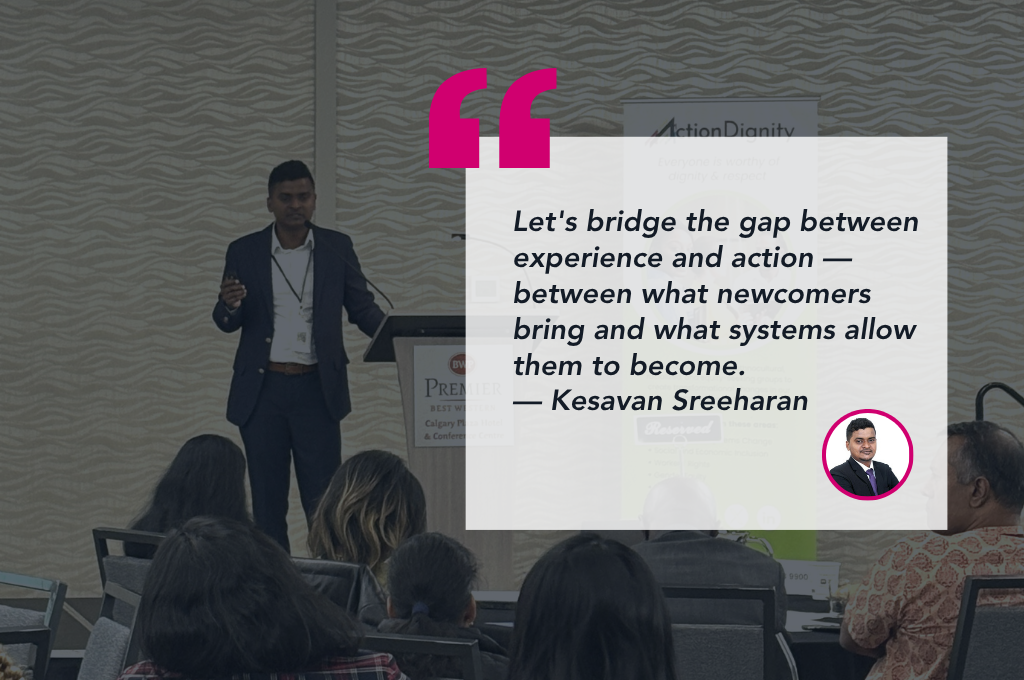
Editor’s Note: At ActionDignity’s Newcomers Research Symposium last November, Kesavan—an internationally experienced humanitarian and development professional who arrived in Calgary in 2024—shared a powerful keynote rooted in his lived experience. Drawing from his journey navigating the Canadian employment system, his speech connected personal challenges with broader systemic barriers, offering both reflection and a call to action for more inclusive pathways.
“We’re looking for someone with Canadian experience.”
That one sentence changed how I understood systems.
My name is Kesavan, and I came to Calgary from Sri Lanka in 2024, bringing over a decade of experience in humanitarian and development work. I had led projects in community resilience, youth empowerment, and post-crisis inclusion. Naturally, I assumed those experiences would translate into the Canadian job market.
But I soon realized something important: employment integration is not only about skills. It’s about recognition. It’s about belonging.
I moved to Calgary to reunite with my wife—hopeful, ready to contribute, and confident in the experience I carried. But very quickly, I encountered the invisible walls many newcomers face: requests for “Canadian experience,” limited professional networks, challenges with credential recognition, and difficulty translating international leadership into local roles.
Through volunteering and mentorship, I found strength in community. These spaces helped me rebuild confidence and reimagine my path. That’s when I realized: integration is not a solo journey. It’s a shared process.
Over time, I began to understand that these challenges weren’t personal—they were systemic. Employment integration isn’t just about jobs. It’s about the systems, mindsets, and structures that shape opportunities.
I started naming these barriers clearly, because they need to be seen:
- The Canadian Experience Paradox—you need Canadian experience to get a job, but you need a job to get Canadian experience.
- Credential recognition processes that are lengthy, expensive, and often undervalue international qualifications.
- Network gaps that make opportunities difficult to access.
- And the reality of survival jobs, where skilled professionals work far below their qualifications just to get a foot in the door.
These are not individual shortcomings. These are systemic gaps that call for change.
What truly shifted my journey wasn’t a policy—it was people.
Through volunteering, mentorship, and newcomer networks, I found spaces where my experience was valued and my voice mattered. Community provided what formal systems often miss: practical guidance, emotional support, opportunities to contribute, and recognition of lived experience.
The newcomer community became a source of resilience, knowledge-sharing, and mutual support.
If we want systems change, we must also shift how we see newcomers—from job seekers, to partners, to innovators. Newcomers are not problems to solve. We are solutions waiting to be embraced.
To make that shift real, we need intentional pathways:
- Empower newcomers through mentorship with professionals who understand both their potential and the local context.
- Bridge employers and talent by creating meaningful access to internationally trained professionals.
- Value lived experience, recognizing the skills gained through navigating complex systems and cross-cultural transitions.
- Support community leadership by investing in newcomer-led initiatives that understand challenges from the inside.
As I closed my keynote, I left the room with one question—and I leave it with you now:
How can we move from understanding newcomer experiences… to transforming the systems that shape them?
Because when newcomers thrive, Canada thrives.